

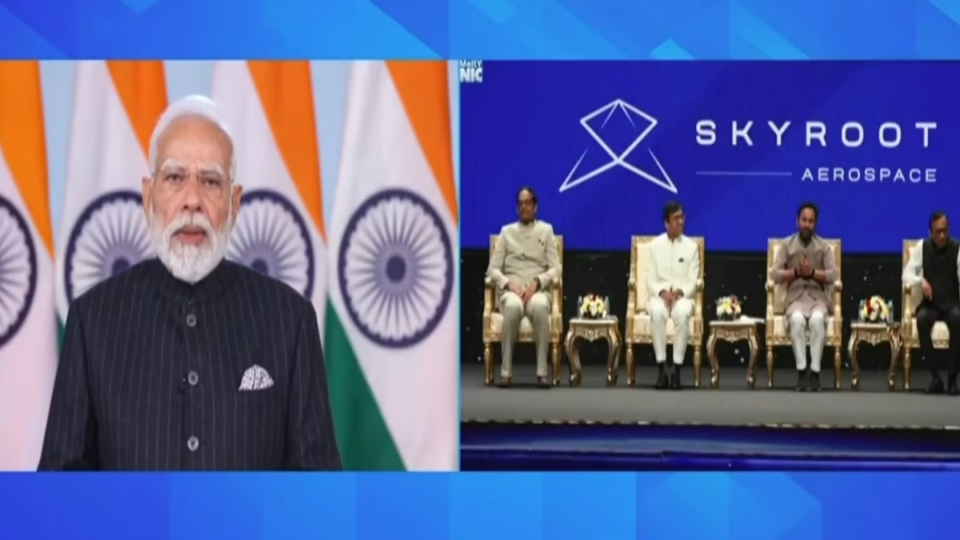
Hyderabad, Telangana: Prime Minister Narendra Modi today inaugurated Skyroot Aerospace’s new Infinity Campus in Hyderabad through video conferencing, marking a milestone moment for India’s private space sector.
Speaking at the launch, the Prime Minister highlighted the rapid transformation of India’s space ecosystem, noting that private enterprises are now playing a pivotal role in shaping the country’s future in satellite launches and space innovation. He described Skyroot’s new facility as a symbol of India’s youthful energy, innovation, and entrepreneurial spirit.
Modi praised Skyroot founders Pawan Kumar Chandana and Naga Bharath Daka, calling them role models for aspiring space entrepreneurs. He emphasized that their willingness to take risks and pursue bold ideas has inspired a new generation of innovators across the country.
India’s Space Journey: From Bicycles to Rockets
Reflecting on India’s humble beginnings in space exploration, the Prime Minister recalled how rocket parts were once transported on bicycles. Today, India is recognized globally for building reliable and cost-effective launch vehicles. He credited ISRO for decades of pioneering work that established India’s credibility in the sector.
Private Sector Driving Growth
Modi underlined that the government’s reforms—such as opening the space sector to private players and introducing a new Space Policy—have created an innovation-driven ecosystem. Initiatives like IN-SPACe now allow startups to access ISRO’s infrastructure and expertise, accelerating collaboration between industry and research.
He noted that more than 300 space startups have emerged in recent years, many starting with small teams and limited resources but driven by determination. This surge, he said, represents India’s “Private Space Revolution,” with young engineers and scientists developing technologies in propulsion, materials, rocket stages, and satellite platforms.
Global Opportunities Ahead
With demand for small satellites rising worldwide, Modi stressed that India is well-positioned to capture a significant share of the global space economy. He pointed out that international companies are increasingly looking to India for satellite manufacturing, launch services, and technology partnerships.
Broader Startup Revolution
The Prime Minister connected the growth of space startups to India’s wider entrepreneurial wave across sectors like FinTech, AgriTech, HealthTech, and ClimateTech. He noted that India is now the third-largest startup ecosystem globally, with over 1.5 lakh registered startups, many achieving unicorn status. He also highlighted progress in semiconductors and deep-tech manufacturing, where government initiatives are strengthening India’s role in the global electronics supply chain.
Expanding Research and Innovation
Modi emphasized the importance of research for future growth, citing the establishment of the National Research Foundation, the ₹1 lakh crore R&D Innovation Fund, and the expansion of Atal Tinkering Labs nationwide. He reiterated that India’s youth will be central to driving innovation in the coming decades.
Skyroot’s Infinity Campus
Skyroot’s new facility spans 200,000 square feet and is designed to support the end-to-end development of launch vehicles. The campus has the capacity to produce one orbital rocket per month, making it a cornerstone of India’s private space ambitions.
Founded by former ISRO scientists and IIT alumni Pawan Chandana and Bharath Daka, Skyroot made history in November 2022 by launching Vikram-S, the first privately developed rocket from India.
Conclusion
Congratulating the Skyroot team, Modi urged India’s youth and entrepreneurs to seize the opportunities ahead and make the 21st century “the century of India—on Earth and in space.” Union Minister G. Kishan Reddy and other dignitaries also attended the event.