

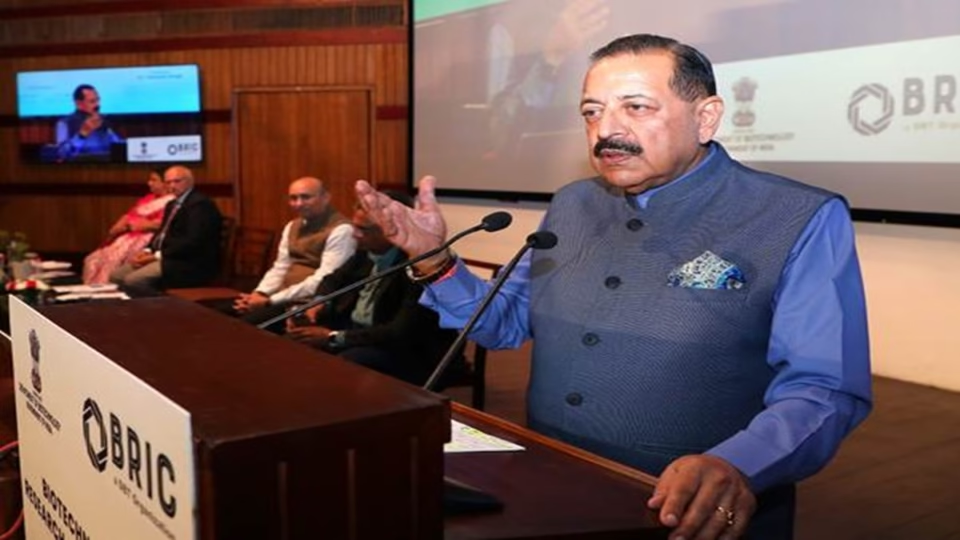
New Delhi, India :
Union Minister Dr. Jitendra Singh said India has already begun the shift toward a new industrial era powered by biotechnology while delivering the inaugural address at the second Foundation Day of the Biotechnology Research & Innovation Council (BRIC) at the BRIC–National Institute of Immunology in New Delhi.
Biotech policy and institutional integration
Dr. Singh highlighted the government’s BioE3 policy as a defining step that places India among a small group of countries with a dedicated national biotechnology framework. He praised the Department of Biotechnology (DBT) for building a cohesive, high‑energy scientific ecosystem and noted that a major reform — bringing 14 autonomous biotech institutions together under BRIC — has strengthened coordination, promoted innovation, and increased impact across the sector.
Collaboration over silos
The minister emphasized that the era of isolated work is ending. BRIC’s model, he said, demonstrates a shift toward cross‑disciplinary collaboration linking biotechnology, medical research, agriculture, and data science. BRIC now works closely with other government science departments, academic institutions including IITs and medical colleges, and the private sector to speed up applied research and commercialization.
Leadership in the Fourth Industrial Revolution
Describing biotechnology as a primary engine of growth in the Fourth Industrial Revolution, Dr. Singh argued that India is preparing to lead, not follow, as global economic growth becomes increasingly bio‑centric. He pointed to BRIC and BIRAC as successful public–private partnership examples that have earned recognition on international platforms.
Launches and milestones
Dr. Singh launched the BRIC–BIRAC Entrepreneur‑in‑Residence (EIR) Program at the event and inaugurated a first‑of‑its‑kind NHP‑ABSL‑3 facility. He cited domestic achievements such as advanced biosafety infrastructure, progress in hemophilia gene therapy, and India’s strengthened global standing after the pandemic vaccine effort — transitions that moved the country from a consumer to a provider of preventive healthcare solutions.
Bioeconomy growth and startup impact
The minister underlined the role of startups and government initiatives under the Bio‑economy Mission in driving economic gains. He noted that India’s bioeconomy has expanded rapidly from about USD 10 billion to over USD 130 billion, with forecasts pointing toward USD 300 billion in the years ahead.
DBT and BRIC performance metrics
Dr. Rajesh S. Gokhale, Secretary of DBT and Director‑General of BRIC, reviewed three years of BRIC activity: thousands of publications, over a hundred patents, multiple technologies commercialized, and a strong pipeline of doctoral and post‑doctoral researchers. He also reported strong response to the Design for BioE3 Challenge and announced plans for a BRIC Bio‑Enterprise Innovation Park on a 200‑acre campus in Faridabad to boost entrepreneurship.
Closing outlook
Dr. Jitendra Singh closed the ceremony expressing confidence in India’s biotech future, saying the best from DBT and the nation is still ahead and that the path to a developed India will run through advances in biotechnology. The celebration included DBT and BRIC leaders and industry and academic figures such as Dr. Kalaivani Ganesan, Dr. Anand Deshpande, Prof. Santishree Dhulipudi Pandit, Dr. P. M. Murali, and other dignitaries.