

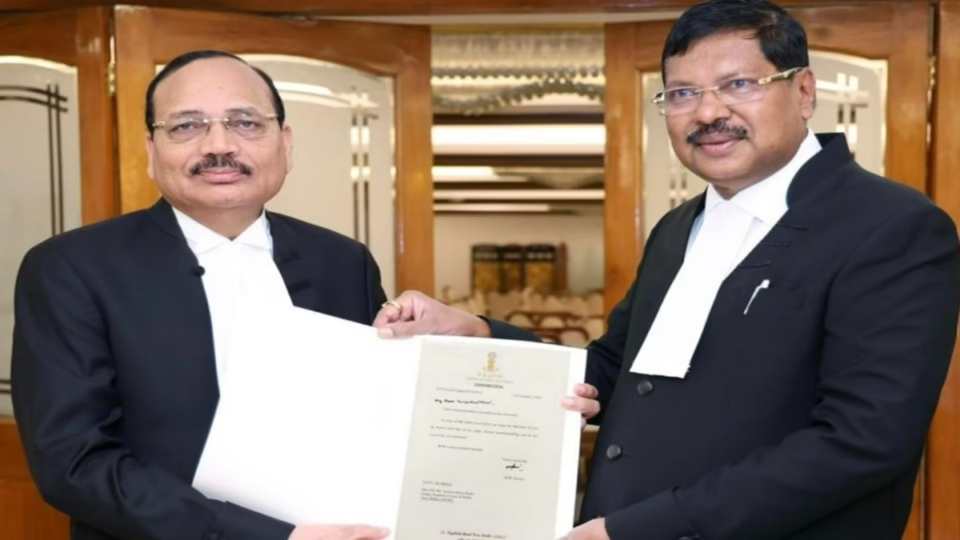
New Delhi : Justice B.R. Gavai, who retires on November 23, 2025, leaves behind a legacy rooted in constitutional values and social justice. Elevated as the 52nd Chief Justice of India in May 2025, his appointment was historic: he became the first Buddhist and only the second Scheduled Caste judge to hold the nation’s highest judicial office, after Justice K.G. Balakrishnan.
During his brief but impactful tenure, Gavai emphasized access to justice, judicial efficiency, and constitutional morality. He launched initiatives like the NALSA Jagriti Scheme, aimed at strengthening legal aid delivery, and introduced administrative reforms to streamline case management in the Supreme Court. His speeches often highlighted the judiciary’s role in protecting marginalized communities and ensuring that constitutional promises translate into lived realities.
Born in Amravati, Maharashtra, in 1960, Gavai’s journey was shaped by his father R.S. Gavai, a social activist and politician. This background instilled in him a deep commitment to equality and public service. His elevation was celebrated as a moment of representation for communities historically underrepresented in India’s judiciary.
The Transition to Justice Surya Kant
With Gavai’s retirement, the mantle passes to Justice Surya Kant, who will take oath on November 24, 2025, as the 53rd Chief Justice of India. His appointment follows the long-standing convention of seniority, reaffirming the judiciary’s commitment to orderly succession.
Justice Kant’s tenure is expected to last until February 9, 2027, giving him a relatively long period at the helm compared to his predecessor. This extended tenure is significant because it allows him to preside over several high-profile constitutional and social cases, ranging from cyber law and criminal justice to electoral integrity and institutional reforms
Justice Surya Kant’s Background and Career
Born on February 10, 1962, in Hisar, Haryana, Justice Surya Kant comes from a modest middle-class family. He pursued his undergraduate studies at Government Post Graduate College, Hisar, and earned his law degree from Maharishi Dayanand University, Rohtak, in 1984.
His legal career began with rapid recognition as an advocate in Punjab and Haryana High Court, where he was known for his sharp arguments and commitment to constitutional principles. He was appointed as a judge of the Punjab and Haryana High Court in 2001, later serving as its Chief Justice before being elevated to the Supreme Court in 2019.
Throughout his judicial career, Kant has been associated with progressive rulings on constitutional rights, environmental protection, and institutional accountability. His judgments often reflect a balance between safeguarding individual liberties and ensuring institutional stability.
The Oath Ceremony and International Attention
Justice Kant’s oath-taking ceremony will be held in New Delhi on November 24, 2025, coinciding with Constitution Day celebrations. The event is expected to be attended by over 15 foreign dignitaries, including the Chief Justices of Bhutan, Kenya, Mauritius, Nepal, and Sri Lanka. This international presence underscores the symbolic importance of India’s judiciary in the global democratic landscape.
Challenges and Opportunities Ahead
As the new Chief Justice, Surya Kant faces a demanding docket. Some of the pressing issues before his bench include:
- Electoral reforms: Cases related to campaign finance, electoral bonds, and voting rights.
- Digital and cyber law: Addressing privacy concerns, data protection, and AI regulation.
- Criminal justice reforms: Tackling delays, prison overcrowding, and custodial rights.
- Constitutional disputes: Federalism, minority rights, and challenges to legislative actions.
His tenure will also be closely watched for how he manages the Supreme Court’s backlog of cases and whether he continues Gavai’s emphasis on judicial efficiency and access to justice.
Continuity and Change in Judicial Leadership
The transition from Gavai to Kant reflects the Supreme Court’s tradition of continuity through seniority, but also highlights the diversity of India’s judicial leadership. Gavai’s tenure was historic for representation, while Kant’s promises to be impactful for its length and the breadth of issues he will oversee.
This change at the helm is not merely administrative—it shapes the judicial philosophy and priorities of the institution. With Gavai’s emphasis on inclusivity and Kant’s reputation for constitutional rigor, the Supreme Court enters a new phase of leadership that blends social justice with institutional reform.