

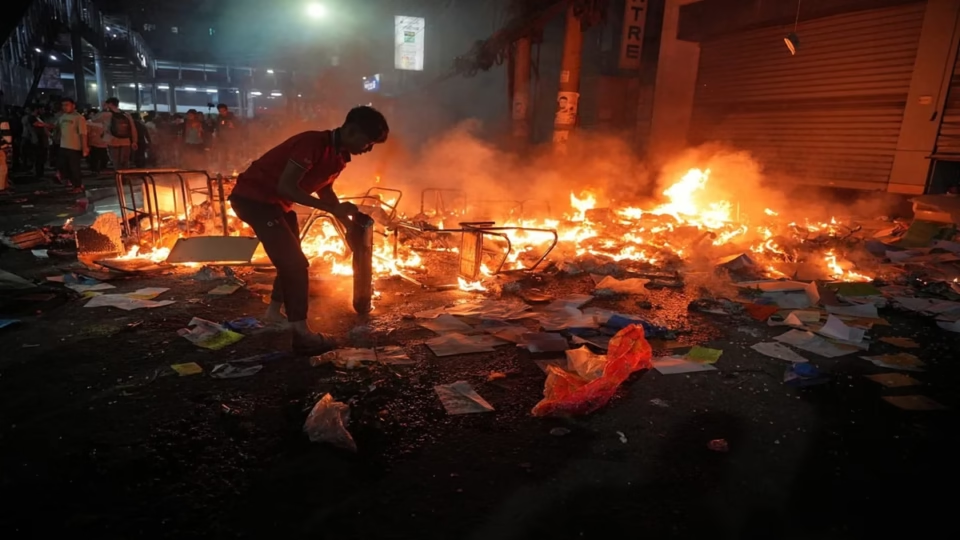
Dhaka, Bangladesh: Bangladesh has been plunged into turmoil following the killing of youth leader Sharif Osman Hadi, a prominent figure associated with the July Uprising that toppled Sheikh Hasina’s government earlier in 2025. Hadi, known for his radical politics and outspoken criticism of India, was shot in Dhaka on December 12 by masked assailants. He succumbed to his injuries six days later in Singapore. His death triggered widespread protests, arson, and mob violence across Bangladesh, with attacks on media houses, cultural institutions, and political offices.
The unrest has not remained confined to Bangladesh’s domestic sphere. It has spilled into the diplomatic domain, raising alarm in New Delhi, where policymakers fear that the deteriorating law and order situation could destabilize bilateral relations and delay Bangladesh’s scheduled parliamentary elections in February 2026.
Escalation of Violence
The funeral of Hadi in Dhaka became a flashpoint. Thousands of mourners attempted to march toward the Parliament, prompting security forces to intervene. Reports indicate that media offices such as Prothom Alo and cultural centers like Chhayanaut were vandalized, while communal tensions flared with the lynching of a Hindu man in Mymensingh. These incidents underscore the fragile state of Bangladesh’s social fabric, where political violence often intersects with communal fault lines.
The interim government, led by Chief Adviser Muhammad Yunus, has appealed for calm, describing the unrest as the work of “fringe elements.” Yet the scale of protests suggests deeper discontent, particularly among youth groups and opposition factions who see Hadi’s death as politically motivated.
Why India Is Concerned
India’s worries stem from several interconnected factors:
- Security of Indian Missions: Protesters hurled stones at the Assistant Indian High Commissioner’s residence in Chattogram, signaling that Indian diplomatic staff could become targets.
- Election Uncertainty: New Delhi has long supported stable governance in Dhaka, fearing that prolonged unrest could derail the February elections and create a power vacuum.
- Cross-Border Implications: Bangladesh shares a long, porous border with India’s eastern states. Instability could lead to refugee flows, smuggling, or militant infiltration, reminiscent of past crises.
- Anti-India Sentiment: Hadi was known for his anti-India rhetoric. His death has paradoxically fueled nationalist anger against India, with some protesters blaming New Delhi for tacitly supporting rival factions.
Diplomatic Fallout
The unrest has already strained Bangladesh–India relations, which had been improving after the July transition. The Diplomat notes that Hadi’s alleged killer was linked to the Awami League and reportedly fled to India, further complicating perceptions. This narrative risks inflaming suspicions that India is meddling in Bangladesh’s internal politics.
India’s foreign ministry has adopted a cautious tone, urging restraint and emphasizing its commitment to Bangladesh’s stability. However, behind closed doors, officials are reportedly concerned that the unrest could embolden anti-India groups and jeopardize ongoing cooperation in areas such as trade, water sharing, and counterterrorism.
Regional and Global Dimensions
The crisis is not just bilateral. Bangladesh’s unrest resonates across South Asia:
- China’s Watchful Eye: Beijing has invested heavily in Bangladesh’s infrastructure. Instability could open opportunities for China to expand influence at India’s expense.
- Impact on SAARC Dynamics: Regional cooperation initiatives may stall if Bangladesh remains unstable.
- International Reactions: The U.S. and EU have expressed concern, particularly over communal violence and attacks on journalists. India, as Bangladesh’s closest neighbor, faces pressure to play a stabilizing role without appearing interventionist.
Historical Context
Bangladesh has a history of political violence, often revolving around charismatic leaders. The assassination of Hadi recalls earlier episodes where the death of a political figure ignited mass protests. For India, memories of the 1971 refugee crisis and subsequent insurgencies in its northeast remain vivid. Any repeat of such instability could strain resources and security apparatus.
Risks Ahead
Several risks loom large:
- Election Delay: If unrest continues, February’s polls may be postponed, prolonging uncertainty.
- Communal Polarization: Attacks on minorities could escalate, destabilizing Bangladesh’s pluralistic society.
- Border Security: India may face increased challenges in managing migration and smuggling.
- Diplomatic Strain: Anti-India narratives could harden, complicating cooperation on trade and connectivity projects.
India’s Possible Responses
India has limited but significant options:
- Strengthening Border Security: Enhanced surveillance and coordination with BSF to prevent spillover effects.
- Diplomatic Engagement: Quiet dialogue with Bangladesh’s interim government to encourage stability and timely elections.
- Regional Cooperation: Working with partners like the U.S. and EU to support democratic processes in Bangladesh.
- Humanitarian Preparedness: Readying contingency plans for refugee inflows, particularly in West Bengal and Assam.
Conclusion
The death of Sharif Osman Hadi has become more than a domestic tragedy; it is a geopolitical flashpoint. For Bangladesh, it exposes deep divisions and the fragility of its democratic transition. For India, it raises alarms about security, diplomacy, and regional stability. As protests continue and elections approach, New Delhi must tread carefully—balancing its strategic interests with the imperative of supporting peace in its closest neighbor.
The coming weeks will be decisive. If Bangladesh stabilizes, India can resume its focus on trade and connectivity. If unrest deepens, however, India may find itself confronting a crisis reminiscent of past upheavals, with profound implications for South Asia’s future.

