

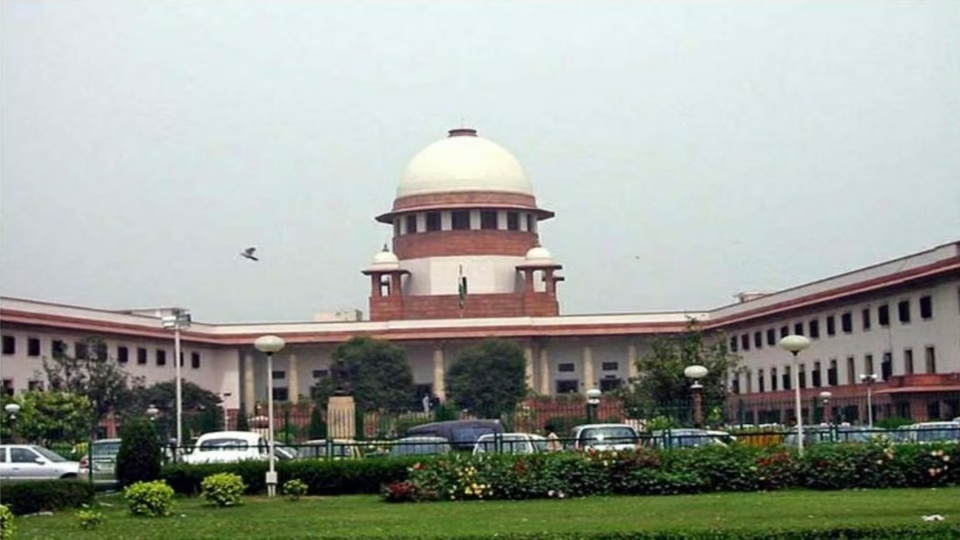
New Delhi : The Supreme Court of India has taken an extraordinary step to combat the rising menace of cybercrime, particularly the alarming spread of “digital arrest” scams, by handing sweeping powers to the Central Bureau of Investigation (CBI) for a nationwide probe. This move, announced on December 1, 2025, marks a turning point in India’s legal and technological response to online fraud, signaling that the judiciary views cybercrime as a national security and public safety issue requiring immediate, coordinated action.
🚨 What Are “Digital Arrest” Scams?
Digital arrest scams are a relatively new but fast‑growing form of cyber fraud. In these cases:
- Fraudsters impersonate law enforcement officers, court officials, or government agency representatives.
- Victims are contacted via audio or video calls, often through apps like WhatsApp or Telegram.
- The scammers intimidate victims by claiming they are under investigation or facing arrest for alleged crimes such as money laundering or illegal transactions.
- Victims are coerced into transferring money to “secure accounts” or paying “fines” to avoid arrest.
- In some cases, victims are virtually “held hostage” during long video calls, pressured into compliance.
This scam exploits fear and lack of awareness, and has already claimed thousands of victims across India, with losses running into crores of rupees.
⚖️ Supreme Court’s Intervention
Recognizing the urgency, a bench led by Chief Justice Surya Kant and Justice Joymalya Bagchi took suo motu cognizance of the issue. The Court directed:
- All FIRs related to digital arrest scams must be handed over to the CBI.
- The CBI has full authority to investigate bank accounts used in frauds and examine the role of bankers under the Prevention of Corruption Act.
- States, including opposition‑ruled West Bengal, Tamil Nadu, Karnataka, and Telangana, must grant consent to the CBI to probe cases in their jurisdictions.
- The Reserve Bank of India (RBI) was asked to explain why Artificial Intelligence (AI) and machine learning tools are not being used to detect and freeze fraudulent accounts.
- Social media intermediaries and telecom operators were instructed to cooperate fully with investigators.
🔍 Why This Matters
The Court’s decision reflects a broader concern: cybercrime is no longer a niche issue but a mainstream threat to financial security, governance, and public trust.
- Scale of the problem: India has seen a surge in cyber fraud complaints, with “digital arrest” scams emerging as one of the most dangerous trends.
- Cross‑border links: Many scams are believed to be operated from outside India, involving international syndicates.
- Banking vulnerabilities: Fraudsters exploit loopholes in banking systems, often opening accounts with fake documents.
- Public panic: Victims often include educated professionals, showing that awareness alone is not enough.
By centralizing investigations under the CBI, the Court aims to create a unified national response rather than fragmented state‑level probes.
🛡️ Role of Technology in Fighting Cybercrime
The Supreme Court’s emphasis on AI and machine learning highlights the need for tech‑driven policing. Potential applications include:
- Real‑time monitoring of suspicious transactions.
- Pattern recognition to detect fraud rings operating across multiple states.
- Automated freezing of accounts linked to scams.
- Voice and video analysis to trace impersonators.
The RBI’s response will be crucial in determining how quickly India can deploy such tools.
📊 Wider Implications
- Legal Framework Strengthening: The Court’s directive may lead to new laws or amendments targeting cyber fraud, including stricter KYC norms for banks.
- Public Awareness Campaigns: Expect government and media campaigns educating citizens about digital arrest scams.
- International Cooperation: Since many scams originate abroad, India may seek treaties or partnerships for cross‑border cybercrime investigations.
- Corporate Responsibility: Telecom companies, messaging platforms, and banks will face greater accountability in preventing fraud.
🗣️ Voices from the Bench
Chief Justice Surya Kant emphasized that digital arrest scams require “immediate national‑level attention” and cannot be left to piecemeal state investigations. Justice Bagchi noted that structured responses are needed, beginning with digital arrest cases and expanding to other cybercrimes later.
🌐 Public Reaction
The ruling has been widely welcomed:
- Legal experts see it as a landmark moment in cyber law enforcement.
- Victims’ groups hope it will bring justice and deter future scams.
- Banks and fintech firms are cautious, as the directive means closer scrutiny of their compliance systems.
📌 Conclusion
The Supreme Court’s intervention against cybercrime—especially digital arrest scams—marks a historic step in India’s fight against online fraud. By empowering the CBI, demanding AI‑driven solutions from the RBI, and insisting on cooperation from states and corporations, the Court has laid the foundation for a national cybercrime strategy.
This case underscores a critical truth: in the digital age, crime is borderless, fast‑moving, and deeply disruptive. India’s judiciary has recognized that only a centralized, technology‑driven, and legally empowered response can protect citizens from the growing menace of cyber fraud.