
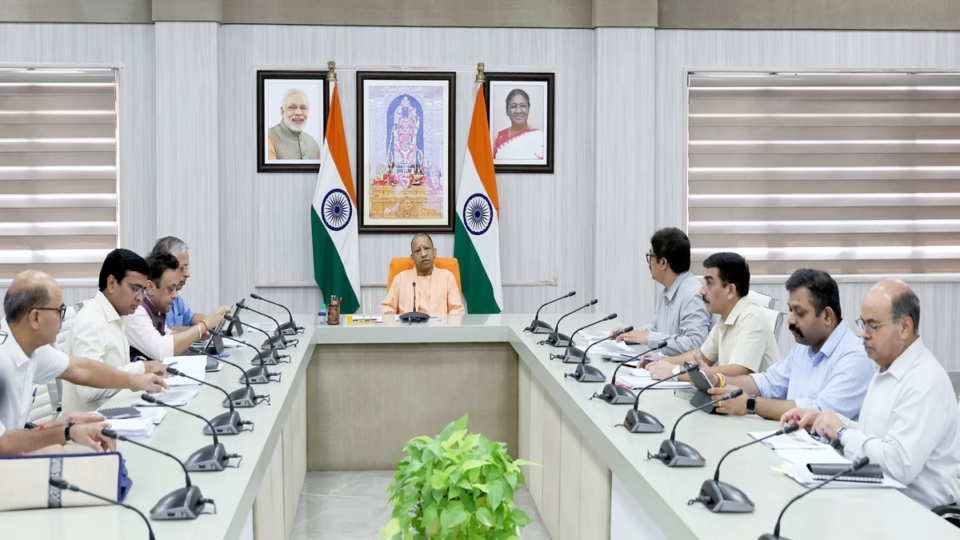
Uttar Pradesh : Chief Minister Yogi Adityanath chaired a high-level meeting at his official residence to review the functioning of the Housing Department. Emphasizing the rapid transformation of urban landscapes across the state, he stressed the need for a comprehensive Urban Redevelopment Policy that goes beyond rebuilding structures and focuses on holistic urban rejuvenation.
Vision for Livable and Sustainable Cities
“Our cities are not just clusters of buildings—they are vibrant social ecosystems,” the Chief Minister said. He called for a policy that balances modernity, tradition, and humanity, aiming to revitalize dilapidated and underutilized urban areas with modern infrastructure, public amenities, and environmental sustainability.
He directed officials to ensure the policy promotes:
- Land reorganization
- Private investment
- Transparent rehabilitation mechanisms
- Livelihood protection for affected families
Every project must uphold the principle of public interest, with no adverse impact on property or livelihoods. A just and humane approach should guide implementation.
Institutional and Strategic Framework
The Chief Minister proposed the creation of a State-Level Redevelopment Authority, a Single Window Approval System, and prioritization of the PPP model to encourage private sector participation. He emphasized the inclusion of:
- Green building standards
- Energy efficiency
- Sustainable development norms in all projects
Preserving Heritage and Local Identity
Special attention must be given to protecting the historical and cultural identity of cities. He instructed the Housing Department to develop area-specific strategies for:
- Old marketplaces
- Government housing complexes
- Industrial zones
- Unauthorized settlements
Priority should be given to redeveloping retired government housing, aging housing societies, and encroachment-affected areas. The final draft of the policy should incorporate suggestions from public representatives, urban bodies, and citizens, and be submitted to the Cabinet for approval.
Reforming External Development Charges
The meeting also addressed the issue of External Development Charges (EDC) levied by development authorities. CM Yogi called for a practical and citizen-friendly approach, noting that the current uniform rates across residential, commercial, industrial, and agricultural land use are not feasible.
He directed that:
- EDC rates should vary based on location and land use
- Agricultural and industrial land should attract lower charges than residential or commercial land
- Rates should differ within and outside municipal boundaries to balance investor and citizen interests
Transparent and Accessible EDC System
The Chief Minister emphasized the need for a transparent and simplified EDC calculation system, enabling citizens to compute charges independently. The formula should be clear, online, and minimally dependent on manual intervention.
He also stressed that revenue from EDC must be used strictly for developing external infrastructure such as roads, water supply, sewerage, stormwater drainage, electricity, and other public utilities. Development authorities must be held accountable for this.
The Housing Department has been instructed to review existing provisions and prepare a transparent, practical, and citizen-centric policy draft to accelerate urban development and deliver real benefits to residents.